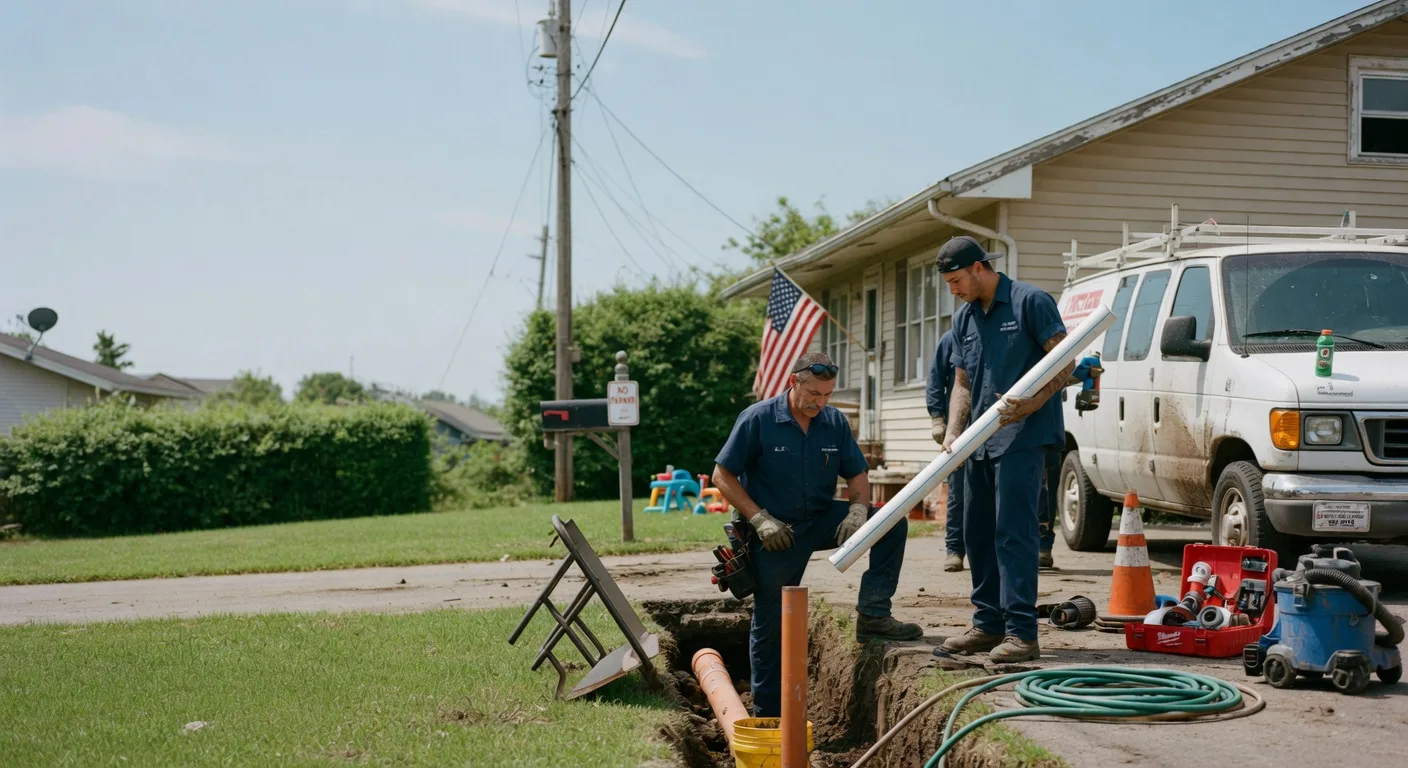
What does a camera inspection show and is it worth it?
A camera inspection feeds a waterproof lens on a flexible cable through the line, usually from a cleanout, and shows what is happening inside the pipe on a screen. It shows a cracked or offset joint, roots growing in through a seam, a bellied section holding standing water, grease coating the wall, or scale narrowing a cast iron pipe. Each of those looks different on camera, and each calls for a different fix. Clay pipe tends to show root intrusion at the joints. Cast iron shows a rough, flaking interior that narrows year by year. PVC usually shows a smooth wall, so a clog there is more likely debris or a low spot. The value is that a cable or jet only clears the blockage, while a camera shows what caused it. It is worth doing any time a drain clogs repeatedly in the same place, when several fixtures back up together, or before any repair or lining work is planned, so the plumber fixes the right section. A camera paired with a locator can also mark how deep the pipe runs. A plumber in Porterville, CA can run one and explain what it shows, and Expert Plumbers Co can connect you with one.
What you do with the footage matters as much as the inspection itself. Ask the plumber to show you the screen while the camera is in the line, or to save the video, and to point out the distance from the cleanout where each problem sits. That distance lets you compare the findings with what you know about the house, such as the location of a tree, a driveway, or an addition. If you are buying or selling a home, a recording of the sewer line gives both sides something concrete to look at. Keep the video, since a later plumber can compare it with the line's current state. A camera cannot see through standing water, so a bellied section may show only as a pool rather than a clear view. Tell the plumber if the line has been jetted recently, as a clean pipe gives a clearer picture.
Why does my basement floor drain back up when it rains?
A floor drain that backs up when it rains is usually not a clog in the drain itself. It means the sewer line outside the house is full, and the water has nowhere to go but up through the lowest opening, which is your basement floor.
Heavy rain can push extra water into the main line through cracked joints, root intrusion at a clay joint or a failed sewer lateral. The line fills, and the floor drain shows it first.
Safe homeowner check: on a dry day, pour a bucket of water into the floor drain and see if it runs away normally. Keep stored items off the floor, and do not run the washer, showers or dishwasher during the storm.
Stop running water and call now if sewage is rising, the smell is strong, or every drain in the house is gurgling or backing up. That points to the main line, not one fixture.
A cable machine can clear roots or grease when a blockage is the cause. If the line keeps filling in wet weather, a camera inspection is the next step, because it shows whether the pipe is cracked, bellied or breached. Hydro jetting washes the pipe wall once the cause is known. Cost depends on access, how much has to be opened up, the materials involved and any permit requirement.
Expert Plumbers Co is a referral service. Call (380) 262-9173 and we will connect you with a plumber serving Porterville, CA for Emergency Drain Cleaning or a camera inspection.
Pay attention to how fast the drain responds, because it tells you how serious the cause is. If the water rises within minutes of a downpour starting and drops soon after it ends, the line is being overloaded by water entering through cracks or joints. If it stays up for hours after the rain stops, something is also holding water in the pipe, such as a belly or a root mass. Older homes often have clay or cast iron lines with many joints and sometimes a downspout or foundation drain connected to the sewer, which makes wet-weather backups more likely. Newer homes with plastic pipe usually have fewer joints, so a backup there points more strongly to a blockage or a municipal main running full. Tell the plumber when the backups began, how heavy the rain was, and whether any gutters or sump discharge are tied into the house drains. Once the cause is fixed, the floor drain should stay quiet through storms.
What causes scale build-up inside old cast iron drain pipes?
Scale in cast iron is rust and mineral deposit growing on the inside wall of the pipe. Cast iron corrodes from the inside over decades. The rust forms rough lumps, called tubercles, and minerals carried in the water settle on them. Grease, soap residue and paper then catch on that rough surface and the bore gets smaller.
The homeowner sees it as drains that slow down over time, often more than one fixture at once, and gurgling when a tub or washer empties. The pipe can look fine from outside while the opening inside has shrunk to a fraction of its size.
A cable machine will punch a hole through the scale, but the water often keeps running through a narrow channel and the build-up returns. Hydro jetting strips the wall back much more completely. Before either one, a camera inspection is worth having on old iron. It shows how much scale there is and whether the pipe wall is thin, cracked or flaking, because a line that is weak can fail once the scale holding it together is cleaned off.
What the job costs depends on access, the pipe material involved, how much has to be opened up or removed, and any permit or code requirement. If sewage is backing up into the house, stop running water and call. Expert Plumbers Co is a referral service. We refer you to a local plumber for Drain Cleaning or Emergency Drain Cleaning in Porterville, CA: (380) 262-9173.
A point many people miss is that cleaning scale is not always the end of the story. Once the wall is stripped back, the bare iron can start rusting again, so the line may need cleaning more than once over the years if the pipe is not replaced. Another sign it is getting worse is rusty or dark water standing in a drain that used to run clear, or small flakes of rust in a trap. In homes built before plastic pipe became common, a camera also shows whether the line is worth keeping or is near the end of its life. Pipes that are thin or cracked may need a section replaced, and that can be done in stages rather than all at once. When you call, mention the age of the house and any previous repairs to the drains, since patches in old iron often use different materials.
What does it mean if the cable machine stops at the same distance every time?
The cable stops dead at the same spot every time, and the plumber says it feels like a wall. That tells you the problem is fixed in one place. It is not a soft blockage that moves.
Common causes are tree roots that have grown in at a clay pipe joint, a section that has dropped or cracked, or a bellied line where the pipe sags and holds water. It can also be a bad coupling where one pipe no longer lines up with the next. A cable can punch through roots or grease, but it cannot get past a pipe that has shifted or broken.
Note the distance the cable went in. That number tells the next plumber where to look, and whether the fault is inside the house or out in the yard.
Safe homeowner check: if only one fixture is slow, go easy on water and note which drain it is. Stop running water and call now if several drains back up, if water comes up in a tub or floor drain, or if there is a sewage smell indoors.
A camera inspection is the right next step, because it shows what the cable hit. Roots or heavy grease may clear with hydro jetting. A broken or bellied pipe is a repair, and the cost depends on access, how much has to be dug or opened, the materials, and any permit required. Expert Plumbers Co is a referral service. Call (380) 262-9173 and we will connect you with a plumber in Porterville, CA for Drain Cleaning.
Mark the spot where the stoppage sits if the cleanout or access point makes that possible, and tell the plumber whether the line runs under a slab, a driveway or a lawn. That decides how the repair is approached and how much has to be opened up. In older homes, the stoppage is often a clay joint that has been invaded by roots or has slipped, and the fix may be a spot repair on one section instead of replacing the whole run. In newer homes a stop at the same distance is more often a poorly set joint or a fitting that was installed out of line. After the camera has found the fault, ask for the footage or a few stills. They show the pipe material, the condition on either side of the problem and whether other weak points are coming. Until the repair is done, expect the line to clog again, so keep water use low and avoid putting anything but waste and paper into it.
The outdoor drain by my driveway, patio or basement stairwell floods in heavy rain. Who clears that?
"The drain by my driveway floods every time it rains hard." Outdoor drains at driveways, patios and basement stairwells fail in heavy rain because they are built to move a lot of water quickly, and leaves, silt and gravel stop that. The grate clogs, then the pipe below fills.
The first thing to know is where it goes. Many exterior area drains tie into a storm line or a dry well, not the sanitary sewer. Some connect to the house drain, and rules vary by area on whether that is allowed. Where the pipe ends decides who can service it, what tools make sense and whether a permit is involved.
Common causes are packed leaves and silt in the drain body, a pipe crushed or shifted by a root or vehicle, tree roots entering a joint, a pipe with too little fall so it holds water, and a storm line that is full or backed up downstream. In a stairwell, the pipe often runs to a lower point and can clog with mud.
If one outdoor drain floods and the rest of the house drains normally, the blockage is in that outdoor branch. If basement floor drains and toilets back up in the same storm, the drain may be tied to the house drain or the main line is overloaded. Check which, because that changes the repair.
Safe homeowner check: Take the grate off and clear leaves and debris by hand with gloves. Look into the drain with a light. Pour a bucket of water in and watch if it drains or stands. Note whether the problem happens only in heavy rain. Do not stand in standing water near electric outlets, and do not poke the pipe with a rod that could crack it.
Stop running water and call now if water is entering the house through a door or foundation, a basement drain is rising, sewage smell comes with the flooding, or the water backs up into indoor fixtures.
A cable machine can clear soft debris and some roots. Hydro jetting is better for packed silt and fine roots in a longer run. A camera inspection helps when the drain keeps flooding, because it shows a collapsed section, a belly holding water, or where the line actually discharges.
Expert Plumbers Co is a referral service. We connect you with an independent local plumber in Porterville, CA. Call (380) 262-9173.
Ask the plumber where the drain discharges and whether it can be reached with a cleanout. Ask whether a repair or regrading is needed, not just clearing. Cost depends on access, the parts or materials needed, how much of the paving or soil has to be opened up or removed, and any permit or code requirement.